


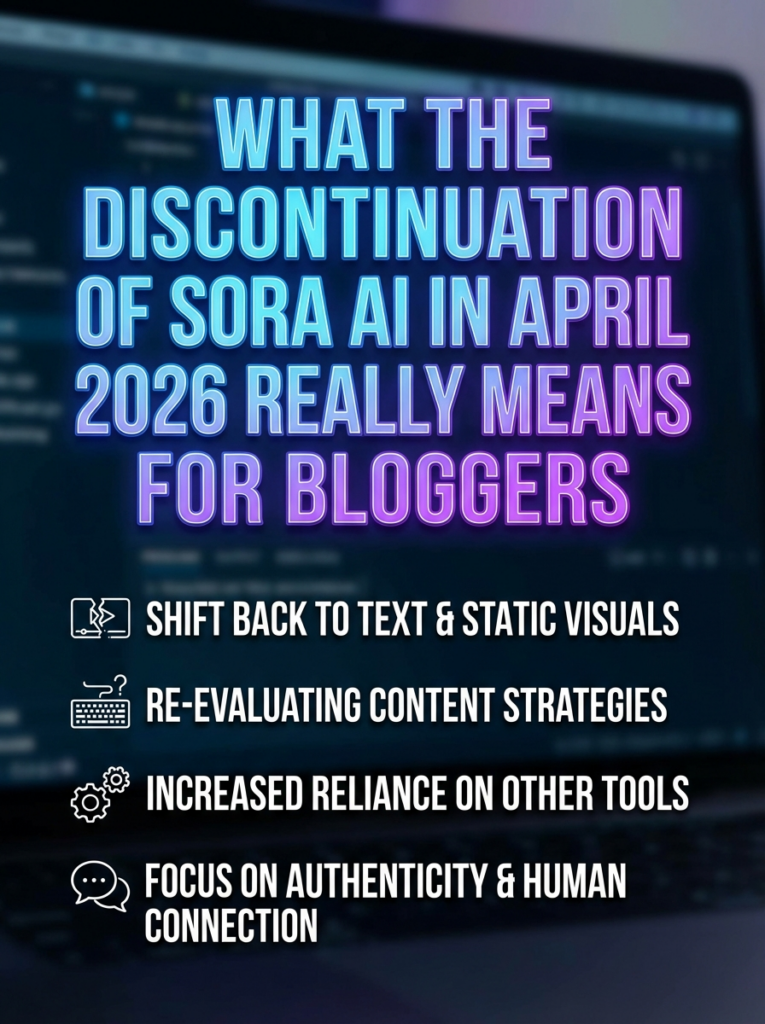
When Sora first started getting attention, it felt like one of those tools that could genuinely change how bloggers work. Not just because it could generate video, but because it connected writing to visual content in a way that felt simple. You could take a blog post and turn it into scenes, clips, or short form content without needing a full video production setup.
Now that OpenAI has confirmed Sora will be discontinued in its current consumer form, with the web and app experiences ending on April 26, 2026 and API access ending later in the year, the conversation around it has shifted completely. This is no longer speculation. It is a scheduled shutdown that has already been publicly confirmed through OpenAI’s own documentation and supported by multiple tech outlets.
For bloggers, especially those who were starting to build workflows around Sora or use it as a marketing tool, this raises a very real question. What happens when a tool you are actively using for content creation is suddenly removed from the picture?
This article is an extension of the earlier discussion about using Sora as a blogging tool, but now we are looking at it through a more grounded lens. Not hype, not speculation, but what is actually happening and what it means for people trying to build consistent content online using Ai.
The Facts: What Is Actually Being Shut Down
OpenAI has confirmed the following timeline:
- Sora web and app experiences end on April 26, 2026
- Sora API access ends later in 2026
- Users are expected to export or save their content before shutdown
The company has not positioned this as a failure of the product, but rather a shift in focus. According to reporting and statements from OpenAI, the decision is tied to resource allocation, infrastructure demands, and a broader shift toward core AI systems and next generation models.
It is also important to understand that Sora’s type of technology is extremely expensive to run at scale. Video generation requires significantly more compute power than text or image generation, which makes long term consumer deployment more complicated than it appears on the surface.
So while the word “discontinued” sounds final, what is actually happening is a strategic pullback from consumer access in its current form.
Why Sora Mattered So Much for Bloggers
Before talking about the impact of its shutdown, it is worth being honest about why Sora got so much attention in the blogging world in the first place.
Blogging has always had one limitation: it is primarily text based.
Even when bloggers branch into images or social media, the process usually looks like this:
- Write blog post
- Create images separately
- Manually edit or outsource video
- Repurpose content across platforms
Sora was one of many Ai products emerging in 2025 that changed that workflow by connecting writing to visual output in a much more direct way. Suddenly, a single blog post could become:
- Short form video clips, being comedic, satire, or serious
- Visual storytelling content
- Social media reels or previews
- Embedded media inside blog articles
- Eye-catching content to use as Instagram reels, or on tiktok for engagement
That is why it was especially appealing to newer bloggers. It reduced friction. It made content multiplication feel more accessible.
For bloggers trying to grow traffic through platforms like Pinterest, YouTube Shorts, or even embedded blog media, that mattered a lot.
Why the Discontinuation Actually Hits Creators Hard
The impact of Sora being removed is not just about losing a tool. It is about losing part of a workflow that some creators had already started to depend on.
For example, a typical AI assisted blogging process might look like this:
- Write a long form blog post
- Use Sora to generate visual clips based on sections of the post
- Post those clips on social platforms
- Drive traffic back to the blog
When one part of that system disappears, the entire structure needs to be rebuilt.
This is especially difficult for smaller bloggers who do not have teams or budgets for video production. AI tools like Sora were acting as a bridge between written content and visual marketing.
Without that bridge, creators either have to simplify their strategy or find new tools quickly.
The Bigger Truth: AI Tools Are Not Stable Infrastructure Yet
One of the most important lessons this situation highlights is something many creators are still learning the hard way.
AI tools are not permanent infrastructure.
They are fast moving products that can change direction, pricing, or availability with relatively short notice.
We have already seen this pattern across multiple AI categories:
- Writing tools shifting from free access to paid models
- Image generators changing policies or output restrictions
- Video tools entering and exiting beta phases quickly
Sora fits directly into that pattern. Even though it gained attention quickly, its lifecycle in consumer form has been short, and its shutdown reflects how experimental this space still is.
For bloggers, this means one thing very clearly: building a content strategy around a single AI platform is risky.
What Bloggers Should Take From This
If you were using Sora primarily to gain followers for your blog, the most important takeaway is not to panic, you have plenty of other options to use for engagement. If you were planning to use Sora as part of your blogging workflow, especially for image or video creation to complement written content, this shutdown is a reminder of a couple things.
First, don’t rely too heavily on any one platform unless you are prepared for change down the line. No matter how promising a tool seems today, the tech world moves fast and priorities shift quickly.
Second, the capabilities that made Sora unique are not disappearing entirely. They are likely to be folded into broader creative tools, workflows, or integrated into platforms that combine text, image, and video generation in more integrated ways. That may ultimately be good news, even if the standalone product is gone.
For now, bloggers will need to explore alternatives that maintain similar capabilities or adjust content strategies to use tools that are stable and likely to stick around. It can be disorienting when a tool you liked quietly disappears, but it can also be a chance to rethink how you approach creative content in general.
Here is what this situation actually teaches:
1. Your blog content must exist independently of tools
Tools should enhance your workflow, not define it. Your ideas and writing need to stand on their own.
2. Build flexible workflows, not fixed systems
Instead of “I use this one tool for video,” think “I can create video in multiple ways depending on what is available.”
3. Expect change in AI tools
This is not a stable industry yet. Tools will come and go, and adaptation is part of the process.
What Comes Next After Sora
Even though Sora is being discontinued in its current form, the broader direction of AI in content creation is not slowing down. This announcement was a moment that surprised a lot of people. It came suddenly, ended a high‑profile partnership with major industry players, and reminded many of us that even the most hyped technology is still subject to business realities and shifting priorities. The broader story of AI‑driven creative tools is far from over. The next wave of innovation will build on what we learned from Sora and similar tools — and that means the future of creative blogging and AI‑enhanced content is still wide open.
If anything, things are now expanding into more integrated systems where:
- Writing tools automatically suggest visuals
- Blog platforms include built in video generation
- Social media tools convert text to short form content
- AI agents handle multi format publishing workflows
Sora was an early version of that direction, not the final version of it.
The removal of one tool does not remove the trend. It just resets the playing field temporarily. This is all just a reminder of how quickly the AI landscape is shifting, especially for creators who are trying to build consistent systems around it.
For bloggers, the real takeaway is more about understanding what actually drives content success.
Tools will change. Platforms will evolve. Some will disappear entirely.
But, the core of blogging always stays the same. That is… to have clear ideas, consistent publishing and focus on human connection and true authenticity of your brand. And, you need the ability to adapt when the tools around you do not stay still. On my end, I have shifted my own workflow toward using Higgsfield for video creation and content repurposing. It has become a more stable part of my process as I adjust to the changes in the AI video space, especially with Sora being phased out.



Leave a Reply